
Pushing boundaries: Julia Graham looks back on 50 years in risk
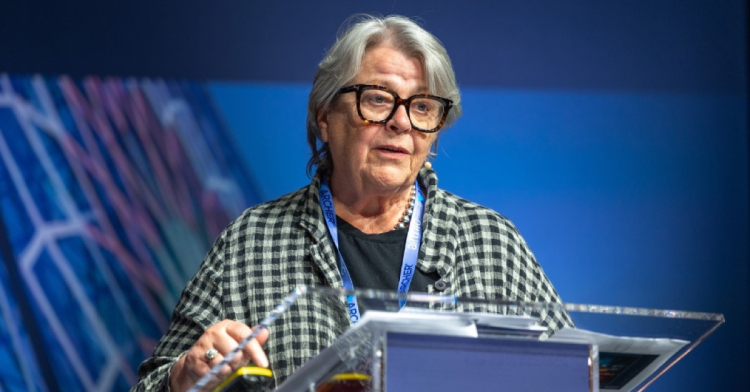
Julia Graham's departure marks the end of an era – not just for Graham or Airmic, but for the UK risk profession which will lose a rare breed: a true pioneer in the field of risk.
It’s a little-known fact that Julia Graham began her professional life in the army, following in the footsteps of her parents and grandparents.
It was a short-lived move as she quickly realised it wasn’t her calling, but the grit and determination instilled at Sandhurst and from her military upbringing left a lasting mark on her approach to work and life.
The world was an entirely different place when she took her first job in insurance in 1972, she reflects, and so was risk management. What followed was a colourful international career marked by carving new roles, pushing boundaries and a true passion for the risk profession.
The birth of enterprise risk management
When Graham began her career, taking what was meant to be a stop-gap insurance role in a bank, risk management was a narrow, insurance-focused and male-dominated discipline.
But Graham enjoyed the problem-solving and analytical side of insurance and – somewhat ahead of her time – could see its strategic value. She quickly gained her insurance associateship in her early twenties and, encouraged by mentors who recognised her drive and aptitude, soon became a City underwriter, later reaching leadership roles.
Enterprise risk management had not yet entered business vocabulary, and crisis management, if it existed at all, was reactive rather than structured. “Risk rarely featured in strategic conversations when I started out,” she reflects.
Over her five-decade career that has changed fundamentally. Risk is now recognised as a career and a profession, with emerging standards, qualifications and influence at board level. It spans geopolitics, cyber, supply chain resilience, reputation and culture as much as traditional insurable exposures.
IRA bombing and 9/11: watershed moments
Graham did not simply observe that evolution, she helped drive it.
Early in her career she was immersed in crisis long before it was codified as a discipline, leading recovery efforts after the IRA bombing of Royal Insurance’s Manchester office and later navigating the ramifications of 9/11.
Those periods were tough to endure, she recalls, but shaped the modern blueprint for crisis response:
“We wrote standards for business continuity and crisis management based on our experience from the Manchester bombings,” she says. “We were invited to tour the world presenting our experience and the lessons we had learned and applied because we were way ahead of the game.”
The events also made clear the need to bring risk in from the periphery. While working at Royal Insurance, which later became Royal & Sun Alliance and now Intact, she authored a board paper for the global head of commercial business arguing that, as an insurer, the company should manage its own internal risk with the same discipline it applied to underwriting. This is standard practice today but was pioneering at the time.
Risk becomes strategic
The result was her appointment as the first head of risk and later head of strategic risk for the merged RSA at a UK level and globally. She built a team spanning strategic risk, internal insurance, environmental risk, business continuity and crisis management.
“This was unheard of at the time but became an early model of the integrated functions now considered good practice,” she reflects.
Graham’s move to DLA Piper – then a medium-sized law firm with big growth ambitions – saw her use her experience, embedding corporate-style risk management in a professional services environment.
“DLA had the vision to give greater strategic importance to risk management,” she says.
Trailblazing for women
As Graham reflects on her career, the major shift in business attitudes to women becomes stark. Entering a male-dominated sector in her twenties, she quickly learned that she’d have to work harder than her male counterparts to gain credibility:
“Women weren’t really taken seriously in those days,” she says. “We were reserved for routine work.”
It is clear that Graham relished shaking up cultural norms. At 25 she became London’s first female city inspector. At 29, returning to work after the birth of her first daughter, she found her job had been given to someone else.
“They simply didn’t believe I was coming back, but I was having none of it and I stood my ground,” she says. “I insisted they reinstate me to the same level of seniority.”
After the birth of her second daughter, not wanting to turn down a work opportunity or be parted from her newborn, with the encouragement and support of her boss, she brought her four-week-old baby into the office and set up a cot.
Those experiences informed her later advocacy. As her influence grew, she has been an active mentor to women and men across the profession and regularly supports initiatives promoting women in risk and insurance.
“Airmic pushed its members to stay relevant”
Graham’s relationship with Airmic spans more than three decades, first as a member, then as chair, and later as technical director, deputy CEO and, latterly, five years as CEO.
During that period Airmic has evolved from an insurance-focused club to a broad community bridging insurance and risk management and offering a wide range of events, education and career support.
“The world was changing fast, with business value shifting from the tangible to the intangible – you could no longer do insurance without a broader risk management understanding. Airmic recognised this change and pushed its members to stay relevant, to become strategic,” she recalls.
One of Graham’s most significant achievements at Airmic has been successfully lobbying for a captive-friendly UK regime. A longstanding advocate for captives and board member of several, Graham played a central role in educating the government on the broader benefits of captives and acting as a conduit for member views.
“It was the result of years of behind-the-scenes hard work from Airmic and other groups such as the LMA, and I couldn’t be more excited when it came to fruition. It’s a testament both to everyone’s lobbying efforts and to the growing maturity of captives worldwide,” she says.
A new chapter
Those who know Graham will give a liberal interpretation to her claims to be “retiring”. While she is stepping away from formal office, her interest in the profession remains undiminished.
She has a portfolio of insurance related non-executive director roles which she plans to grow, a position as a trustee on the board of a charity, and she will continue to work on the development of captives and professional standards, and to consult, speak and write.
Passion can be an overused word. In Graham’s case it feels appropriate. Over 50 years she has helped move risk from the margins to the mainstream. As she departs, the profession she leaves behind is broader, more confident and more influential than the one she entered – a legacy that will endure.