
Together Stronger: FERMA’s next chapter
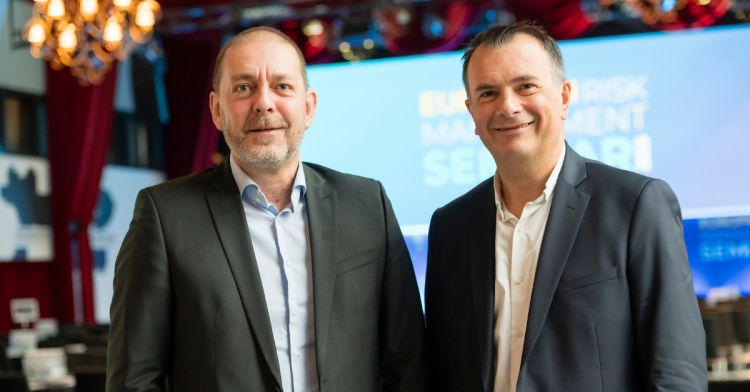
Airmic had an exclusive joint interview with FERMA’s new leadership, President Philippe Cotelle and CEO Laurent Nihoul, where they discussed FERMA’s new priorities, the power of collaboration, and resilience in a fractured world. Their mission? To amplify the voice of risk — in Europe and beyond.
With two major leadership changes in the last four months, 2026 marks a critical juncture in the evolution of FERMA, the Federation of European Risk Management Associations.
The Federation’s new president and CEO are heavyweights in the European risk management community, collectively bringing almost 50 years of managing risk in major multinational corporations.
And they intend to use this experience to bring about tangible change for their member associations. “We have a strong understanding of the needs of risk managers, and we want to use that to have an impact on a daily basis,” says Laurent Nihoul, who previously spent over a decade at ArcelorMittal, marking him as the first senior risk professional to become CEO of FERMA.
Cotelle and Nihoul have served as FERMA board members for over eight years each and bring complementary leadership styles. Together they combine Cotelle's track record for developing ideas with Nihoul's focus on practical execution, creating a pragmatic dynamic.
Their desire to make a noticeable impact in the professional lives of the risk community is palpable: “We’re not interested in vague or empty ideas that look nice – it’s important that we translate words into decisions,” observes Nihoul.
Together Stronger
Cotelle has put collaboration at the heart of his presidency under the theme Together Stronger.
He believes that FERMA’s collective value is greater than the sum of its parts, and that by supporting its member associations to maximise their potential, the whole risk community will benefit.
“Together stronger is about delivering on that potential,” reflects Cotelle. “We should be more united behind the shared purpose and take advantage of our diversity in terms of culture, geography and history to create additional strength. FERMA can be an incredible platform to amplify its collective impact.”
FERMA’s long-standing mission is to represent and defend the interests of its member associations, such as Airmic, to the EU and other European institutions and to raise the profile of the profession at a continental level. It also represents European interests with risk management associations globally. It has a diverse membership across 23 countries, and promotes cohesion through shared knowledge and practices.
A vulnerable international moment
Coming into office during a turbulent and vulnerable moment in the international order has only deepened FERMA’s conviction in the need to find strength in unity. “Change is coming at very high speed – even faster than we expected. Cyber developments, AI, geopolitical tensions, climate change – they are accelerating,” observes Nihoul.
“Being resilient to these changes is about adapting to the new reality. And that comes back to the need for knowledge, expertise and best practice. That’s where FERMA has an essential role, as we can centralise this information and share it.”
Always seeking to put words into practice, Cotelle kicked off his time in office with a President’s Workshop, in which presidents or chairpersons from each of its member associations were invited to meet and exchange ideas on expectations and opportunities, as well as to develop personal relationships and trust.
The meeting, which Airmic chair Richard Hoult attended, created an energy that exceeded expectations. “It was a fantastic meeting because we saw a new dynamic, an enthusiasm across all the different associations. Our aim is to ensure we are working as a community with associations interacting between themselves.”
FERMA’s new direction
Cotelle and Nihoul’s focus on strengthening FERMA’s internal capacity marks a new direction for FERMA, which has, in the past, tended to focus its resources on external advocacy:
“FERMA has, and will continue to be, a voice for the community. But we also believe that we must look ‘inside the circle’,” Nihoul explains.
“We have an incredible pool of resources and if we want to amplify our voice externally, we must ensure it is coordinated. You will see us focusing much more on sharing knowledge, expertise and education.”
At FERMA’s first board meeting under Nihoul in February this year, the Federation agreed on three concrete initiatives.
The first initiative will see the creation of a Next Gen Council at European level. This will consist of one-to-two young professionals from each association, tasked with horizon scanning and idea generation. Individuals will sit on the council for a twelve-month term.
The second is a shared knowledge platform – a library of a selection of member associations’ research, best practice and thought leadership. Associations such as Airmic can choose to contribute research that will support smaller associations that lack the resources to produce their own collateral, although some research will remain open to members only.
The third is a dedicated resource to support associations with small budgets. FERMA’s membership is diverse and while some associations like Airmic are fully staffed, other associations have limited capacity for areas such as thought leadership or marketing.
External advocacy: evolution not revolution
Turning to FERMA’s well-established role in representing the European risk management community in external matters, its members can expect an evolution in policy, not a revolution.
The Federation will continue to push for practical solutions to major systemic risks including the net zero transition, cyber risk and EU crisis preparedness.
Nihoul would like FERMA to focus more on “holistic advocacy” – engaging with a wider net of stakeholders from insurers and brokers to business groups and ensuring FERMA members’ voices are heard more widely.
He plans to increase his engagement with other regional and international risk federations such as RIMS, PARIMA and IFRIMA. “The issues we are tackling, whether its insurance innovation or cyber risk, these go beyond Europe”.
He would also like to deepen FERMA’s relationship with Airmic. “Airmic is one of the key players, one of the most sophisticated associations. It has the largest number of members and sits alongside one of the world’s major insurance markets,” he says.
Under Nihoul, FERMA has recognised Airmic’s representation of the Republic of Ireland. Airmic has historically included members from the Republic, but it has formalised its presence in the country over the past few years, including establishing a regular Island of Ireland conference and its own Airmic Ireland website.
“Risk management has no borders. The UK may not be in the EU anymore, but we have a common destiny,” says Nihoul.
Trust and influence: the measures of success
Cotelle and Nihoul are big on ambition but are mindful of the need to manage time and budget constraints in a not-for-profit organisation.
“This comes back to being a coordinator. We have to find the balance between what we can do ourselves, where we can coordinate, and where we can leverage the expertise of others.”
Getting buy-in from all the associations they represent is also forefront in their minds – which means acknowledging FERMA’s diversity and ensuring their plans add value for all members. While some associations need more practical support, others, such as Airmic, have different needs.
FERMA presidents serve two-year terms, which means Cotelle has a tight window to achieve his objectives. What would he consider success within that timeframe?
“First of all, I would like to reinforce the community feeling across our network, in a way that will last. Secondly, I want FERMA to be organised in such a way that it can make impactful solutions – to become a go-to stakeholder on key topics.”
Nihoul adds that over the long term, he would like to cement FERMA’s influence on finding a solution for the major challenges facing the risk profession, from climate resilience to cyber risk.
“We want to be part of the solution. Not on our own but moving things forward together with other organisations and associations. I believe it’s better to have an impact as a small part of a large collaboration than to have minimal impact in isolation.”