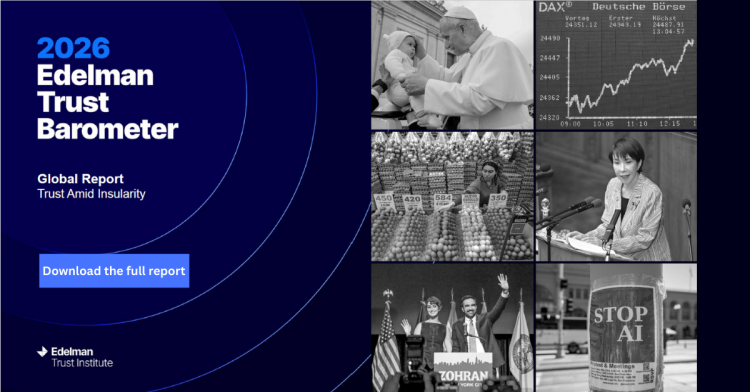
Edelman Trust Barometer: Major survey shows trust in decline and insularity on the rise
Findings have significant implications for risk professionals, AXA’s Matthew Reeves, a speaker at Airmic’s Risk Forum in February, explains.
The 2026 Edelman Trust barometer has revealed a world that is retreating into insularity.
According to the annual survey, now on its 26th edition, as global measures of trust continue to decline across many metrics, people are becoming more resistant to change and less open to unfamiliar ideas and experiences.
“We are choosing a closed ecosystem of trust that mandates a limited worldview, a narrowing of opinion, intellectual stasis, and cultural rigidity,” according to CEO of Edelman, Richard Edelman.
70% of people are either unwilling or hesitant to trust someone whose values, facts, problem-solving approaches or cultural background differ from theirs – so just 30% of people are open to trust across these divides.
As with previous years, AXA has analysed the findings of the Edelman Trust Barometer on behalf of Airmic members, drawing out the key risk takeaways. Matthew Reeves, client relationship leader, UK, AXA XL, has been part of the team for the last seven editions and says the findings deliver important insights for risk professionals, insurers and businesses:
“Trust represents a significant risk to business. Whether it is a decline in trust from your consumers, your employees or the society in which you operate, all facets of trust have a direct impact on the performance and stability of your organisations.”
A call for “frank discussions”
The rise in insularity is the latest manifestation of a longer-term decline in trust, according to Edelman, who calls for “frank discussions” in the workplace, led by the CEOs and leaders. Previous findings suggest the world moved from fear to polarisation, as highlighted in 2023, then to grievance and hostile activism in 2025, and now to insularity.
This presents challenges for businesses, especially multinational corporations, according to Reeves:
“The significantly higher trust for domestic companies over multinationals is a clear risk for global businesses, as it may become harder to sell in key territories, such as Canada, Germany and the UK, all of which have high trust gaps.”
It also has implications for workforce performance: “How do we achieve good operational cohesion between an employee population who may be unwilling to work together?”
Businesses can play a positive role
While Edelman’s work demonstrates that trust, akin to reputation, is difficult to gain and easy to lose, there is positive news for businesses, according to Reeves. The report shows that, despite some declines, most industry sectors remain trusted.
“It has also shown over the years that businesses can lead the charge in rebuilding trust across society.”
Reeves believes this is driven by a general understanding that businesses have an incentive to succeed – and that they are motivated for long-term stability and risk reduction.
“So respondents appear to have faith in business and the role they can play in a positive society. This is aligned to the conclusion that the report comes to, around the actions that business can take in ‘trust-brokering’.”
Matthew Reeves will be speaking in more detail about the findings of the 2026 Edelman Trust Barometer at Airmic’s Risk Forum on 11 February. Tickets are free to members.