
UK captive consultation: A strong start but more needed to be truly competitive

Airmic strongly welcomes PRA/FCA captive proposals but says clarity on PCCs, group captives and a redomicile framework must follow quickly for regime to have international impact.
Airmic CEO, Diane Maxwell, has said that the PRA and FCA’s proposed UK captive regime is an exciting and positive step forward in the UK’s journey to becoming a bespoke onshore captive domicile.
The regulators have listened to and acted on many of the market’s suggestions over the past 14 months, she said:
“The proposals give us optimism that the regulators are on track to produce a compelling and competitive captive domicile. Some areas need further work – and we have provided detailed feedback to the PRA – but overall, this is an excellent and positive start.”
In particular, Airmic welcomes the proportionate approach to capital, commitment to a fast approval process and the range of risks that captives will be permitted to write.
The core proposals: competitive and proportionate
The consultation paper was published on the 14 July and sets out the PRA and FCA’s proposals for a tailored UK captive regime.
Included among the proposals is a captive capital requirement based on the higher of 10% of net written premiums or 10% net insurance liabilities, subject to a minimum capital floor of £100,000. These proposals have been broadly supported across the market and are intended to provide a proportionate and internationally competitive framework.
The regulators have also made it clear they will prioritise a streamlined authorisation process and propose a four-to-six-week turnaround time to approve new licences.
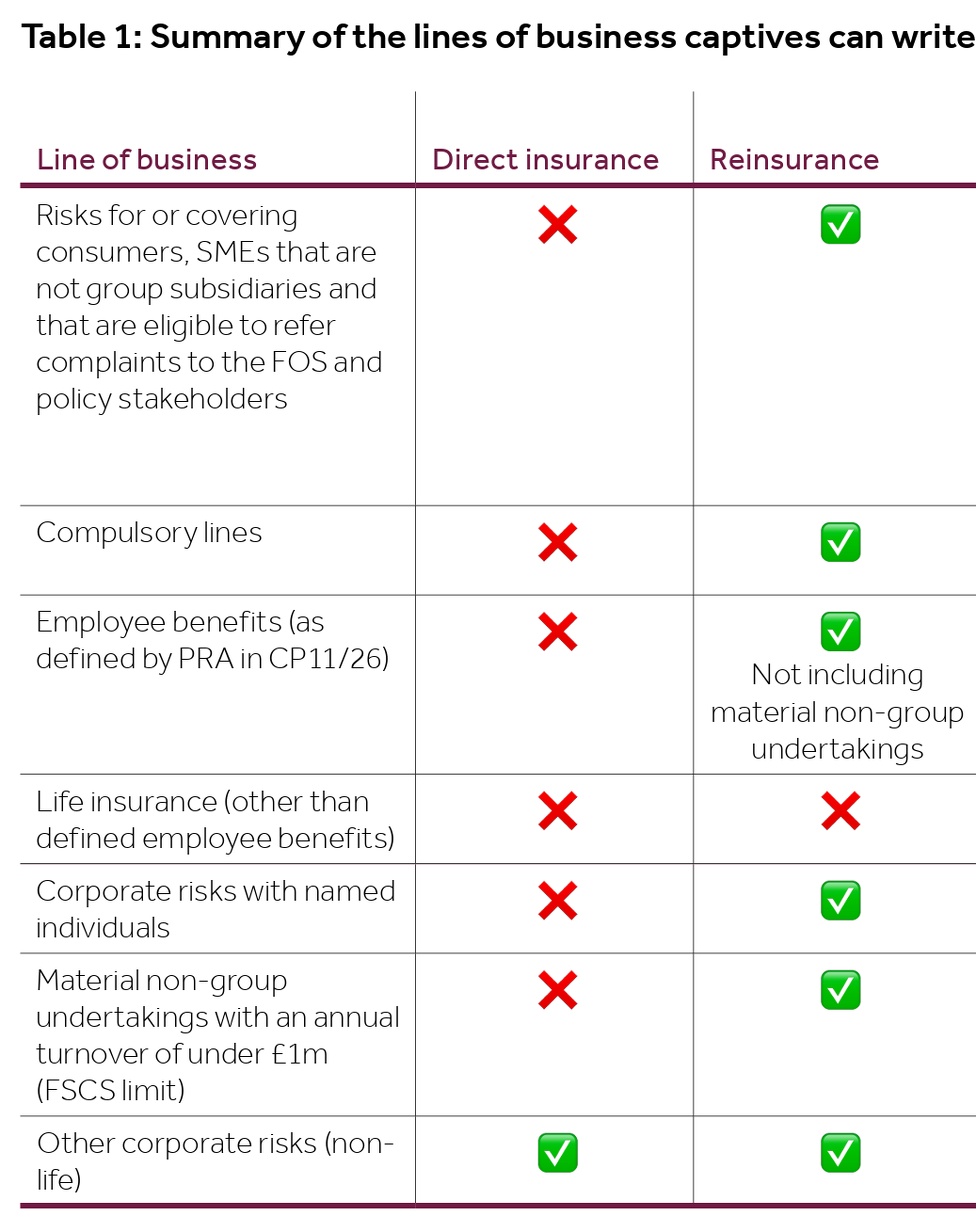
The proposals allow for a broad range of risks to be written, although some risks such as employee benefits will only be permitted on a reinsurance basis, as illustrated in the table below:
Richard Cutcher, Airmic’s captive ambassador, says the proposals demonstrate that the PRA understands that captives should be treated as low-risk vehicles and has designed a bespoke solvency and regulatory regime.
He added: “The rules outline a fairly broad approach to material non-group undertakings, which should permit captives to write a wide range of policies for part-owned subsidiaries, franchisees, significant suppliers and joint ventures, ensuring that numerous business cases can be facilitated within the UK’s captive regime.”
Airmic: “Further work needed”
However, while Airmic has welcomed the proposals, it has highlighted some core areas that need further work and will be calling for the regulators to move forward quickly with the necessary changes and clarifications.
“We recognise the benefits of leaving room for supervisory discretion, but it is this clarity that will help our members make the business case for their organisations to start a new captive in the UK, or redomicile their current one,” said Hoe-Yeong Loke, head of research at Airmic.
The areas requiring further work include:
Employee Benefits (EB): Airmic welcomes the inclusion of EB, though there is concern that the proposed rules may prohibit some EB cover – group life assurance in particular – that is currently already being insured in the UK directly from an offshore or international captive. Airmic is seeking clarification on this, as well as whether a UK captive can reinsure employee benefits for staff based outside the UK (under global benefits programmes) where the front is an equivalent, appropriately regulated non-UK primary insurer.
Protected Cell Companies (PCCs): PCCs are essential for making the regime accessible to a broader range of companies, especially in the mid-market. The PRA has signalled its intention to push through specific PCC legislation next year, a move strongly backed by Airmic.
Group captives / association captives: Airmic is calling for these to be included in the regime, as there has been interest in them from Airmic members particularly from the public sector and mid-market.
Re-domiciliation proposals: The PRA anticipates that approximately half of new captive applications will be from companies with existing captives seeking to relocate to the UK. However, there is currently no legal framework for redomiciliations, which would require primary legislation; this is likely to be a key barrier for many organisations. While this issue sits outside the scope of the captive consultation, Airmic views this as critical for attracting established, international captive domiciles and will be urging the UK government to address this gap.
“The PRA and FCA have set out a solid groundwork for the UK captive regime, but providing clarity on employee benefits, PCCs and group captives is essential and must happen quickly,” said Loke.
“If the UK is serious about incentivising established captives to relocate to the UK, then they must also address the lack of a framework for the redomiciliation process,” he added.
Airmic : Shaping the regime with the PRA
Since the consultation paper was published, Airmic has undergone extensive consultation with its members – both with organisations that have existing captives and those that may consider establishing one for the first time.
Many Airmic members own, manage or are considering a captive, and it is the captives of their organisations which the proposed regime intends to bring onshore.
Airmic has engaged closely with the PRA throughout the consultation process, including through Subject Expert Groups - set up by the PRA in cooperation with the FCA - which have included Airmic members.
“We are all invested in making the upcoming captive regime a successful one that works for the UK and the market,” said Loke. "The work doesn't stop here. We will continue to work with the PRA and listen to as many members as possible as the process continues."
The consultation paper reconfirms the regulators’ commitment to having the regime ready to go live in summer 2027. The PRA has previously stated it hopes to have some ‘first movers’ ready to licence from the outset and strongly advises firms to engage with the regulator early in the process.
While it is not yet clear how quickly the new regime will grow, the first five years is likely to be the most intense period of growth. The consultation paper says that in a low-growth scenario, it anticipates five new approvals a year for the first five years. In a high growth scenario, it could see up to 20 approvals a year.
Airmic has submitted its formal response to the PRA, which can be found here. The submission was shaped by feedback from Airmic members through a series of meetings of the Airmic Captives Special Interest Group (SIG). If you would like to get in contact, please email Airmic’s head of research, Hoe-Yeong Loke, on hoeyeong.loke@airmic.com. The consultation paper can be found on the PRA website here.