
Richard James on managing nuclear risks: “There’s no room for error”
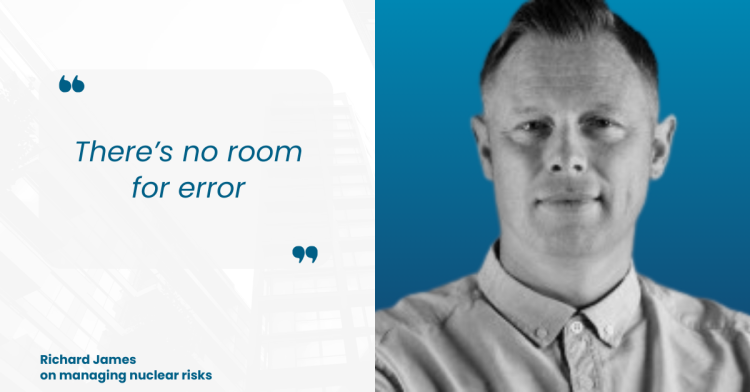
Richard James, head of risk at Nuclear Transport Solutions and deputy chair of Airmic’s Risk Management Steering Committee, spoke to Airmic News about his career, managing risk in a high-stakes sector, and the key risk trends to watch as we move into 2026.
Richard, your early risk management experience came through the police force. What was the appeal of a full-time career in risk?
I’ve always been drawn to professions that are exciting and where the stakes are high for society. That’s what drew me to the police where I had my first experience in managing risk through project management.
Moving into the nuclear space was a natural transition. Nuclear sites are some of the most dangerous places in the world and the materials we hold in the UK are substantial. When it comes to risk, there’s no room for error: we must be proactive and take action.
Like many, I didn’t set out to have a career in risk, but I’ve stayed in it because there’s always something exciting happening. It’s kept me engaged throughout my career.
You talk about the high-risk stakes in the nuclear sector. What unique challenges does this present and what is your role?
NTS is the only organisation in the world with a licence to transport high security category one nuclear materials – the highest risk category – around the world. This demands rigorous standards and utmost scrutiny. Safety and security are at the heart of everything we do – they are integral to our corporate vision.
My role has been to formalise the risk management process and implement a new risk management framework for the whole business. Stakeholder management is central to this given the regulatory demands in this sector.
Managing reputational risk is also vital, especially with the high degree of public interest in nuclear matters. We don’t treat reputation as a standalone risk, but it’s factored into everything we do – it’s a consequence of other risks.
For example, we recognise that our performance in the non-nuclear rail business directly impacts the reputation of our nuclear-related operations. If we can’t deliver products on time for a supermarket, how can people trust us to deliver nuclear fuel safely? So the reputation piece really drives quality and consistency across everything we do.
2025 has been a very volatile year on the international stage, with global trade wars, a retraction in globalisation and key developments in the Russia / Ukraine war. How has this impacted your role?
As a transport and logistics business, supply chain is one of our biggest risks to manage and like many, we’ve been impacted by geopolitics, especially tariff hikes and inflationary pressures from the war in Ukraine.
In this environment, supply chain engagement has been vital – we’ve developed an enriched understanding of our suppliers and their vulnerabilities, and we use this to navigate the risks. Contract negotiation has also been important. Where we can pass on the costs we do, but mitigation doesn’t cover everything.
Over the longer term, our strategy in our rail business has been to reduce supply chain risk by reducing the size and upgrading to a newer and modern fleet. It gives us more depth and flexibility to respond to supply chain challenges.
Global economic losses from national disasters this year are already more than double the long-term average. How is climate change impacting decision making in nuclear transport?
We are certainly seeing extreme weather conditions become more frequent and more intense.
It impacts short-term decisions: if there’s a storm forecast for next week, we have to really consider if we run a service, how to run it, how to build in resilience to the operational plans and manage our routes accordingly.
Over the longer-term, climate change is an emerging risk and horizon scanning is key. The risk of losing access to ports or key rail infrastructure in the UK or overseas is very real. Today it’s manageable, but we have to consider the possible changes over the next twenty and thirty years.
The UK’s Office for Nuclear Regulation listed cyber security as a top-priority risk for 2024 and 2025. Tell me about your approach to cyber risk.
Cyber is one of our biggest risks. There are three parts to it. One, is the national security piece - the ability of a cyber-criminal to undermine nuclear safety and the operational systems that under pin it.
The second is the transport logistics – is it possible for someone to hack into our ships and trains transporting nuclear material? Ironically, the older systems can be more secure because they are less connected, but as fleets modernise the cyber risk increases.
The third is how do we detect, respond and recover from a cyber attack. We’ve invested a lot in technology and talent, and we work with the National Cyber Security Centre to be a leading player in this space. We align with national guidance and standards such as Cyber Essentials and the Cyber Assessment Framework.
As the UK transport infrastructure adopts new technology and AI and moves us towards driverless transport, we’re challenging the sector nationally to ensure they’ve really addressed the cyber implications.
Cyber risk is undoubtedly a growing risk; all businesses can see the rise in threat. But our ability to detect, respond and recover is developing.
How has the risk profession changed over the past decade?
Traditionally, risk management was very focused on how we identify risks and assess their likelihood and impact and put controls in place. It was textbook ISO 31000.
That’s still important, but now it’s more about decision making. How can risk enable better decisions? How can it support the board make right choices around strategy and business objectives?
This shift is partly coming from boards who are constantly reminded by events like Covid that they need to be challenged and take a longer-term perspective on risk. And it’s partly coming from the risk profession which is evolving to be better equipped to play that strategic role.
What will be the key risks or trends to watch in your sector in 2026?
With the global security threats continuing into the new year, the priority will continue to be ensuring our business is safe and secure. With the economic picture uncertain, there will also be a need to proactively manage supply chain and financial risks.
Finally, with the nuclear renaissance in the UK and exciting news about new reactors, I predict there to be plenty of competition for talent. We need to proactively manage our people to ensure that we can retain and attract new talent to our business.