
Innovation, ambition and strategy: Ireland puts insurance sector at heart of its vision
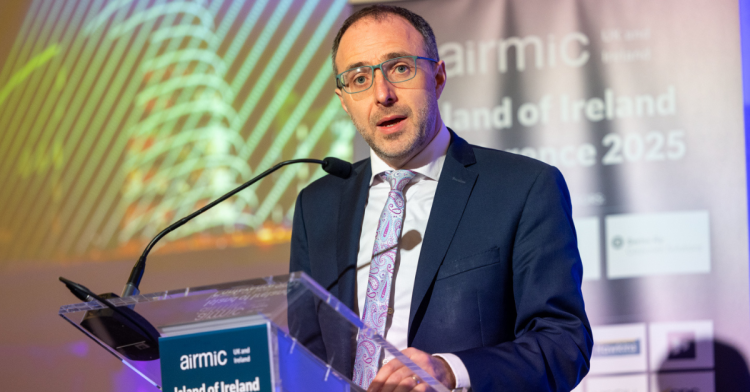
Ireland is emerging as a global centre for insurance innovation and long-term growth, its Minister of State with responsibility for financial services, credit unions and insurance, Robert Troy T.D., told Airmic members. He was speaking in the opening session at the Island of Ireland conference, during which he positioned Ireland as a cutting-edge force of the future.
Ireland has long sought to capitalise on its position as the only English-speaking EU member, but now it is also carving out its own identity centred on a growing reputation for regulatory credibility, its deepening EU influence and technological advancement.
Ireland is now the EU’s largest cross-border exporter of insurance services, home to 178 insurers and nine of the world’s top ten reinsurers, according to analysis by Milliman. According to Troy, these statistics “tell the story of a country that has combined consistency with creativity, regulation with flexibility; and ambition with accountability.”
The destination for international capital, talent and innovation
At the heart of Ireland’s broader insurance strategy is regulatory reform, as mapped out in The Action Plan for Insurance Reform 2025-2029, published this July. The reform is aimed at driving regulatory efficiency, transparency and market stability, while also prioritising growth and innovation.
“The Plan is designed to strengthen our position as a destination for international capital, world-class talent and cutting-edge innovation, while providing global insurers with the stable, forward-looking environment they need to succeed in Europe,” he said.
Innovation was a constant theme throughout the minister’s speech, as he stressed the country’s commitment to new technologies including fintech, as well as attracting private investment in green and digital transitions.
In a “landmark” development next year, Ireland will be hosting a dedicated Lloyd’s Lab Accelerator Cohort, in partnership with Lloyd’s, IDA Ireland and Enterprise Ireland. The Lloyd’s Lab connects start-ups and scale-ups with the world’s largest insurance market place in order to drive and scale new insurance solutions.
Troy believes Ireland’s involvement is “a powerful signal of confidence in Ireland’s resilience, our talent and our growing status as a global hub for insurance innovation.”
The wake of Brexit: seizing opportunity
Ireland considers its success and identity to be deeply intertwined with the EU, and it has used the UK’s exit from the union to its own advantage, he said. “Every crisis contains the seeds of opportunity and Brexit has opened doors for Ireland to attract new business, new talent and new jobs in a way that was previously inconceivable.”
He pointed to the country’s thriving financial services sector, commitment to ICT development and a strong and independent regulator as some of Ireland’s core strengths that have attracted business to the country.
“We have already seen an increase in the number of firms seeking to relocate operations, expand their presence or establish new bases in Ireland and across Europe,” he said.
Ireland has also seen an “influx” of talent in the wake of Brexit, he said: “We are attracting highly skilled specialists in insurance, reinsurance, underwriting and related financial services from across Europe and beyond.”
According to the minister, the country has one of the youngest and most highly educated populations in Europe. “This talent pool is critical to helping Ireland remain at the cutting edge of industry innovation, particularly as we embrace new technologies and navigate emerging challenges.”
A bridge to the future
Ireland occupies a unique place among competing global forces. As Airmic CEO, Julia Graham, told delegates, it has successfully carved out a niche as a bridge between the low tax corporate-friendly culture of America, the more regulatory stringent EU and the strategically important UK.
Troy said the country “did not arrive here by chance,” but rather it is the product of a clear and consistent vision and ambitious reform agenda – at the heart of which is the insurance industry. “You, the people in this room, are central to that - the risk professionals, insurers and innovators who are building Ireland’s bridge to the future.”