
How AI is transforming entire property risk cycle
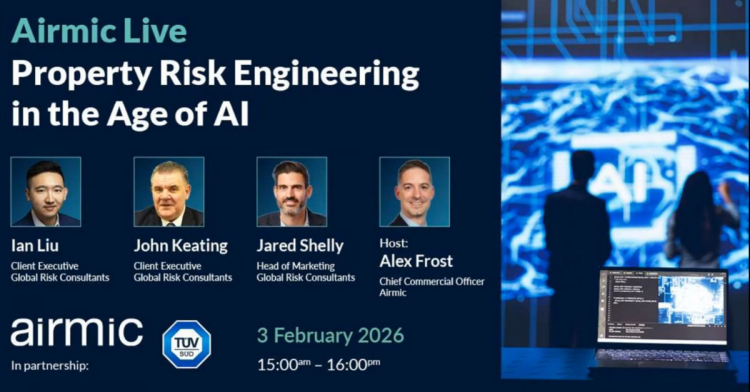
Artificial intelligence is changing how businesses manage and assess property risk – but alongside the opportunities come technical risks and regulatory changes. This month’s Airmic Live webinar with Global Risk Consultants discussed the key trends to watch.
Artificial Intelligence is set to “transform the entire risk cycle for property,” members heard at the latest Airmic Live webinar. An estimated 30% of organisations currently use AI for risk management, but this is set to increase as businesses seek speed, accuracy and improved returns on investment.
AI’s analytical capacity combined with improvements in the Internet of Things, augmented reality and drones, is rewriting data collection. It is shifting from a discrete and fixed process to one that is continuous and in near real-time, according to Ian Liu, client executive at Global Risk Consultants.
Risk assessments and mitigation strategies, for example, will no longer be based on backward-looking descriptive data. Instead, they will increasingly incorporate both predictive analysis and prescriptive analysis, enabling businesses to identify property risks at the early onset or even before they materialise.
“AI will provide pinpoint accuracy and granularity down to which location, which piece of production utility equipment, and which recommendation that should be tackled as a first priority,” explained Liu.
Preventing million-dollar losses
In natural hazard mitigation and prediction, for example, AI models are integrating near real-time weather data, topography information and historical loss data to predict localised weather events such as hail with a 15-minute lead time.
“15 minutes may not sound like a lot, but it can be enough to help, for example, solar farm operators to stow their panels just in time, and save tens of millions of dollars in losses,” according to Liu.
Risk mitigation strategies will also be supported by much greater precision, allowing for more accurate ROI and CapEx decisions. Meanwhile natural language processing models can analyse large volumes of reports and policies to extract key insights, offering what Liu described as a “24/7 risk consultant.”
Insurance: from submissions to pricing
Turning to risk transfer, members heard that AI-powered tools are already reviewing submissions for completeness and quality and identifying data deficiencies pre-submission.
While insurance pricing for large corporates with complex risk profiles is likely to remain bespoke and underwriter-led for the foreseeable future, AI-driven insights are shaping policy terms, capacity decision and technical pricing in some segments.
AI is also supporting compliance with the Insurance Act in the UK, helping businesses meet their “duty of fair presentation,” by facilitating a “reasonable search” for material information, ensuring facts are “substantially correct” and providing sufficient information to put an insurer “on notice” for further enquiries.
AI risk: questions to ask
While the benefits of greater AI reliance in property risk are clear, businesses should be cognisant of the associated risks, which fall broadly into two categories: technical and governance.
On the technical side, data quality, algorithm bias and inconsistent outcomes remain central challenges, and underline the importance of human involvement and oversight.
On the governance side, use of personal and sensitive data for AI purposes is fraught with myriad data protection and regulatory challenges, according Liu.
Questions to consider for businesses, include: what data can be used for developing models? In which jurisdictions should the data reside? What are the implications of cross-border data movement? And what are the cybersecurity differences between private on-premise data and the commercial cloud?
Diverging regulatory approaches
In Europe, the UK and the EU are taking different approaches to AI-related regulation, according to John Keating, managing consultant at Global Risk Consultants.
The EU is taking a more detailed, prescriptive approach based on a four-category scale. Its flagship legislation for AI governance will be fully applicable from 1 August 2027 and will have significant penalties of up to 35 million euros for non-compliance or 7% of global turnover.
The UK, by contrast, is taking a more principles-based approach, relying on existing rules to apply AI use cases. Regulation is guided by the principles of safety, fairness, transparency, accountability and contestability.
Businesses should monitor regulatory changes closely, Keating advised. In the UK, for example, legislation targeting frontier AI – the most powerful AI models – is anticipated as a priority next step.
Get AI-ready
According to Airmic’s Technology Priorities and Perspectives research, only 1% of members report that Generative AI is fully implemented within their organisation, with 11% running pilots. While Gen AI is only one subset of artificial intelligence, it suggests that AI maturity within the risk profession is still in its early phase.
However, the webinar made clear that AI is set to transform property risk in the near future, from data collection to risk mitigation and risk transfer, and that businesses must ensure they have the data and processes to be AI-ready.
The webinar was moderated by Jared Shelly, head of marketing at Global Risk Consultants and hosted by Alex Frost, chief commercial officer at Airmic. Click here to listen to the webinar recording in full.