
From seabed security to space satellites: how Orange manages risk and resilience in turbulent times
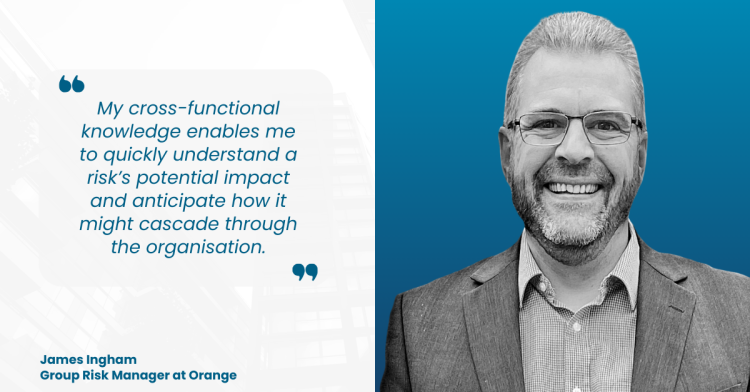
Airmic News spoke to James Ingham, group risk manager at Orange, about the key risks in telecoms, why their risk approach is evolving and how AI is transforming resilience.
James, you’ve spent over thirty years at Orange, working in a range of roles from marketing and product management to innovation, before moving into the risk function as group risk manager five years ago. How has this career path helped you to be a successful risk leader?
It might not be a conventional route into risk, but it’s been hugely beneficial. I’ve gained deep, hands-on experience in how the different parts of Orange’s business operate.
The cross-functional knowledge means I quickly understand the potential impacts of an event and can anticipate how it might cascade through the organisation.
Orange is a complex business with global revenues of about 40 billion euros. As well as supplying mobile broadband services, we provide a range of B2B services such as cyber defence, satellite services and sub-marine cable operations.
Having enterprise-wide operational experience definitely helps me present a holistic view of risk and link it to business outcomes and strategy.
Since becoming group risk manager, you’ve combined formal training with learning organically on the job. In what ways has Airmic supported you?
Airmic has been a huge help. I attend their conference and many of the smaller events and get involved in Special Interest Groups.
Sharing ideas is so important – these events round my knowledge and help me to learn from other industries while benchmarking our own approach to risk. I often come back from their events with new ideas.
I also lean on their resources to keep abreast of topical issues – Friday Reading is a particularly useful example.
Describe your role and the structure of the risk function at Orange.
As the leader of the strategic risk anticipation workstream, my primary focus is on identifying and monitoring emerging risks, so I’m constantly horizon scanning for threats and opportunities that could impact us.
I also play a key role supporting Orange’s group crisis management team, providing rapid analysis of how an unfolding event might evolve and what actions we should consider to protect the business.
I work extensively with our global network of local risk managers, sharing insights and best practice and learning from their on-the-ground-perspectives.
The telecoms sector sits in the intersection of technological, societal and economic change. What are the core risks you currently face?
The pace of transformation in our sector is truly staggering.
Like most multinationals, cyber security and AI are key risks; both are huge opportunities to acquire customers and transform our business, but also significant threats.
Hybrid warfare is becoming a major risk specific to our sector. We've seen attempts to disrupt critical infrastructure like our undersea cable networks, but also cyber and arson attacks.
There are many other sector-specific risks. For example, quantum computing is an opportunity, but it is also a security threat to our networks and an investment risk.
There are increasing risks posed by the proliferation of satellites, particularly in low-earth orbit. For instance the potential for a Kessler effect scenario, where cascading collisions create an impenetrable field of space debris, which could cripple the satellite communications that telco services depend on.
Environmental risks are also rising up the agenda. Water scarcity and related migration trends have implications for network planning and long-term investment. Meanwhile, the Orange commitment to be carbon neutral by 2040 brings operational constraints and impacts our overall strategy.
Geopolitics is on the minds of all business leaders today. How is this impacting your role?
Geopolitical tensions certainly loom large, as they can disrupt our supply chains, impact spectrum allocation decisions, and create barriers to market access. We are head quartered in France, but with 127,000 employees across 26 countries, the current environment is challenging.
Tariffs and trade wars, which can bring technology export restrictions and threats to the availability of rare earth metals needed for equipment and devices, for example, bring supply chain uncertainty with potential impacts on our ability to maintain our network at the right quality levels.
And we've seen how political alliances can sway international bodies like the ITU, which governs global telecommunications standards and spectrum allocation.
How do you build resilience in the face of heightened uncertainty?
Our approach has evolved over the past few years. Before, we relied on broad risk maps designed to consider almost every possibility. Today, we are much more focused. We highlight the risks which may impact us in the short to medium term and identify areas of the business where controls and mitigations need enhancement .
In a world where the speed of risk is increasing and stability is decreasing, this approach works because we’re more focused on organisational resilience rather than managing individual risks.
You mentioned that AI is both a risk to be managed and an opportunity. How is Orange using AI to support its resilience strategy?
We’ve custom built a ‘serious event’ detection system that scans global information sources 24/7, flagging emerging issues that require our attention. It has been trained with our own key risks and every day it produces a report with between five and 20 key topics for us to consider, including insights into potential impacts.
It's not perfect – it still needs a strong human factor – but it spots events we would probably have missed and makes us consider developments in a new light. It’s a really good example of where AI is becoming transformational.
Finally, James, how do you like to spend your days when you’re not working?
I love spending time with my two teenage children and being outdoors – walking, cycling and, more recently, playing golf.
I was lucky to take a six-month sabbatical last year and I cycled the Camino de Santiago trail from Lisbon to northern Spain, which was amazing. It actually gave me a lot of thinking space and time to reflect on risks and I returned with a lot of fresh ideas.